AMCOMCAP.COM BLOG
WORDS OF WISDOM FOR ENTREPRENEURS & BUSINESS OWNERS

Most of our clients pay an average discount rate of about 4.4% per invoice and receive an advance of up to 80% of the invoice’s face value up front. That’s the short answer to the first question almost every business owner asks us: what is this actually going to cost me? A lot of factoring companies get vague here. We’d rather just show you the math.
Your specific rate depends on a handful of things we’ll break down below — and there’s one big misunderstanding we need to clear up first, because it trips up almost everyone.
When people hear “we advance up to 80%,” they sometimes assume the rest is the fee. It isn’t. That’s your money — you just get it in two pieces.
Here’s how it works. When we factor an invoice, we send you most of the value right away (the advance). The rest is held as a reserve. When your customer pays the invoice, we release that reserve back to you, minus our fee. So the only real cost of factoring is the discount fee — that 4.4% average. The advance rate just tells you how much of your cash you get on day one versus a few weeks later.
The discount fee is a percentage of the invoice’s face value, and it’s how we get paid for advancing your cash and handling the collection. On average, our clients pay around 4.4% per invoice — but “average” is doing some work in that sentence, because the fee is tied to time.
Factoring isn’t a flat fee you pay no matter what. The rate is based on how long the invoice stays unpaid. It starts lower and steps up in small increments roughly every 10 to 15 days the invoice remains outstanding. The faster your customer pays, the less you pay us.
Here’s an illustration of how a time-based schedule works. (These tiers are an example to show the mechanics — your actual schedule is set when we quote your account.)
| How long the invoice is outstanding | Discount fee (illustrative) |
|---|---|
| First 15 days | 2.5% |
| 16–30 days | 3.2% |
| 31–45 days | 3.9% |
| 46–60 days | 5.6% |
| 61–75 days | 6.3% |
| 76–90 days | 8.0% |
| 91+ days | 10%+ |
The 4.4% average reflects the fact that most invoices clear somewhere in that 40-to-55-day range. It also points to something useful: getting your customers to pay on time directly lowers your cost. Factoring rewards good billing habits.
Say you factor a $10,000 invoice, with a 75% advance.
If you want that advance, the reserve, and the fee to land correctly in your accounting system, here’s how to record factoring transactions — three ledger accounts and four journal entries.
Now watch what timing does. If that same invoice doesn’t get paid until around day 65, the fee steps up a tier — in our illustration, to roughly 6.3%, or about $630. Same invoice, $190 difference, entirely driven by how long your customer took to pay. That’s the whole logic of a time-based rate.
This is the factor that matters most, so it’s worth understanding clearly. When we factor your invoices, we’re advancing cash against your customers’ promise to pay — so the financial strength of those customers (in factoring terms, your “account debtors”) is what we’re really underwriting. Their credit, not yours, is what carries the invoice.
That has a direct — and sometimes dramatic — effect on price. Invoices billed to large, financially strong, reliably-paying companies (a national retailer, an established manufacturer, a well-capitalized general contractor) carry very little risk of nonpayment, so they earn the lowest discount rates and the highest advances, at or near that 80% ceiling. Invoices to a brand-new business, a chronically slow payer, or a customer with shaky finances carry more risk — so they price higher and may advance lower. Two companies with identical revenue can get very different quotes purely because of who their customers are.
There’s an upside hidden in that: because we’re underwriting your customers rather than you, your own credit doesn’t have to be perfect to qualify — and if you sell to strong, creditworthy customers, their strength works in your favor on both your rate and your advance.
Beyond your customers’ credit, a few other things move the number:
Those same factors also shape where your advance rate lands. Clean receivables with strong customers and little history of disputes earn advances at the higher end.
Just as important as the fee is the stuff that isn’t a fee. With us, there’s no application fee, no processing fee, and no due-diligence fee. You’re not paying to find out whether factoring works for you, and you’re not signing up for a pile of add-on charges buried in the fine print. The discount rate is the cost. If a factoring company can’t give you a straight answer on the total cost of their program, that’s worth paying attention to.
Invoice factoring costs an average discount rate of about 4.4% per invoice, you get up to 80% of each invoice up front, and your exact rate depends mostly on who your customers are and how fast they pay. No application fees, no surprises.
The honest truth is that the only way to know your number is to look at your actual receivables — it takes us a short conversation, and there’s no cost or obligation to find out. Request a free quote and we’ll show you exactly what your rate and advance would look like on your invoices.

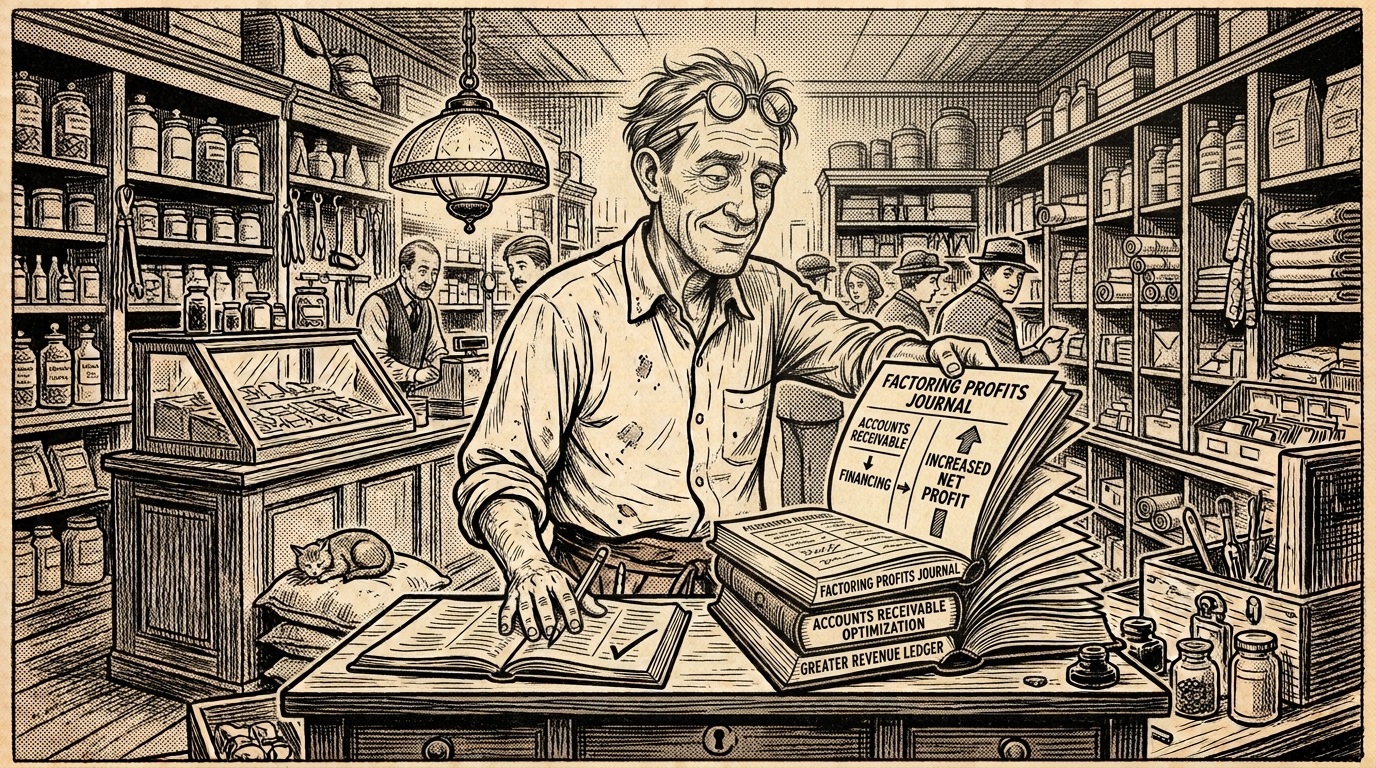
Short answer: For most small businesses with a gross margin above roughly 20%, invoice factoring pays for itself — not because the fee is small, but because the fee is a variable cost that buys sales volume. A machine shop doing $1.2 million a year at a 28% gross margin can add $600,000 in sales, absorb a 4% factoring fee, and still finish the year with roughly 80% more…
Part of our Honest Answers series — straight talk about financing a growing business.
When you start factoring, we send your customer a letter. It tells them to send your payments to us instead of to you.
We call it a first-time purchase letter. The industry calls it a Notice of Assignment. Most guys call it “that letter you send my customer,” and it’s the part they…
Honest Answers from American Commercial Capital
Most advice about starting a B2B business with no money skips the hard part. It tells you to “bootstrap,” “hustle,” and “find investors.” Two of those are useful. The third one costs you the thing you started the business to get in the first place.
Here’s the honest answer: you can start a B2B business with no money — or close…



HOW MUCH COULD FACTORING INCREASE PROFITS FOR YOUR BUSINESS?
CALL 713-227-3863