AMCOMCAP.COM BLOG
WORDS OF WISDOM FOR ENTREPRENEURS & BUSINESS OWNERS

To record factoring transactions accurately, your books need to handle four things a standard accounts-receivable workflow was never built for: the factor’s advance, the withheld reserve, the fee, and the release of that reserve when your customer pays. This guide shows you how to record factoring transactions using three dedicated general-ledger accounts and four simple journal entries — and how to choose between the gross and net-of-discount methods of presenting revenue so your financials stay accurate.
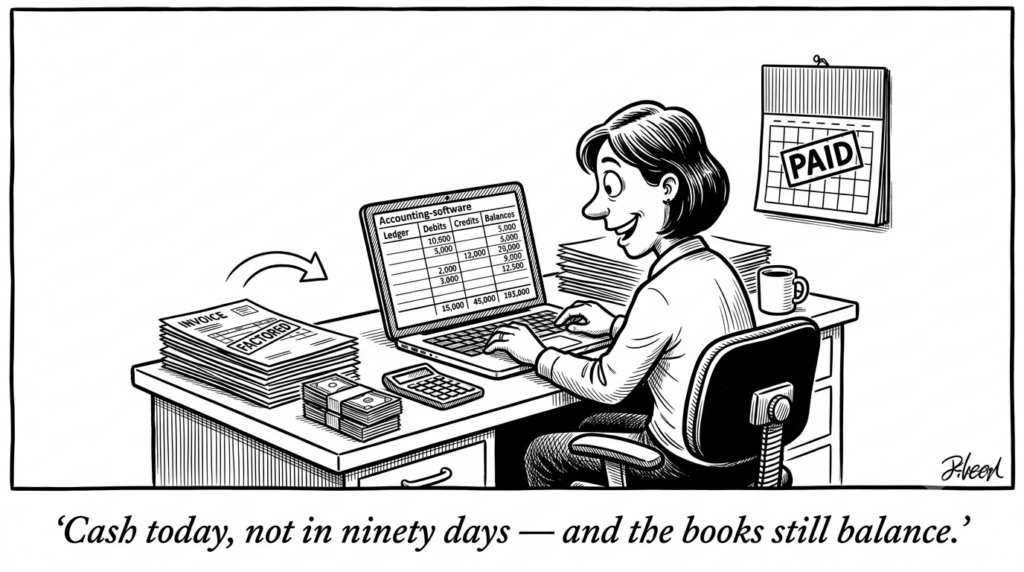
Add these three accounts to your chart of accounts once; from then on they carry all of your factoring activity.
Each factored invoice moves through four entries. Steps 1 and 4 are ordinary A/R entries; Steps 2 and 3 are driven by the Purchase Report and Collection Report your factor provides. The mechanical entries are identical under both revenue methods — only the classification of the fee changes. Percentages below are illustrative (80% advance, 20% reserve, 5% fee); always use the actual figures from your factoring reports.
Identical whether or not you factor — this is your normal sale entry.
| Account | Debit | Credit |
|---|---|---|
| Invoiced A/R | X (100%) | |
| Revenue | X (100%) |
Enter from the Purchase Report. This is a Cash Receipts transaction.
| Account | Debit | Credit |
|---|---|---|
| Cash (net advance received) | X (80%) | |
| A/R Factored Reserves & Fees Withheld | X (20%) | |
| A/R Factored | X (100%) |
Enter from the Collection Report. This is a Cash transaction — the fee lands here.
| Account | Debit | Credit |
|---|---|---|
| Cash (reserve released, net of fee) | X (15%) | |
| A/R Factoring Fees / Discount | X (5%) | |
| A/R Factored Reserves & Fees Withheld | X (20%) |
Enter as a payment against the customer’s invoice, paid out of the A/R Factored bank account.
| Account | Debit | Credit |
|---|---|---|
| A/R Factored | X (100%) | |
| Invoiced A/R | X (100%) |
Factoring involves two separate transactions. First, you sell goods or services to your customer, who owes the full invoice amount. Second — and separately — you sell that receivable to the factor at a discount. Because the discount is the cost of the second transaction, not a change to what your customer owed for the first, there are two accepted ways to present it.
Revenue is recorded at the full invoice value and the factoring discount is shown separately as a financing or operating expense. This is the U.S. GAAP treatment: the sale of the receivable falls under ASC 860 and the discount is a loss on sale of receivables or a financing cost, distinct from the revenue you earned from your customer under ASC 606. Your top line equals what your customers were actually billed.
The A/R Factoring Fees account is classified as a contra-revenue account, so the discount nets against sales and revenue is reported net of factoring discounts. This reflects the view that, in economic substance, the invoice was sold at a discount and the business realized only the net amount. It is common for smaller and tax- or cash-basis books.
Both methods produce the same net income. On a $10,000 invoice with a $500 (5%) fee, the factoring cost is captured either way — it just sits below revenue (Method A) or inside revenue (Method B):
| Method A — Gross | Method B — Net | |
|---|---|---|
| Revenue (customer sale) | $10,000 | $9,500 |
| Less: Factoring fee / discount | ($500) | included above |
| Net income impact | $9,500 | $9,500 |
Note: A factoring discount differs from a settlement discount you offer a customer (e.g., 2/10 net 30). A customer discount reduces the transaction price and always reduces revenue. In factoring, your customer still pays the full invoice — the discount goes to the factor — which is why Method A can legitimately keep revenue gross.
Factor a $10,000 invoice: the factor advances 80% ($8,000), holds a 20% ($2,000) reserve, and charges a 5% ($500) fee. The four entries below are the same under both methods, and every entry balances.
| Step & account | Debit | Credit |
|---|---|---|
| Step 1 — Record the invoice | ||
| Invoiced A/R | $10,000 | |
| Revenue | $10,000 | |
| Step 2 — Sell the invoice (Purchase Report) | ||
| Cash (net advance) | $8,000 | |
| A/R Factored Reserves & Fees Withheld | $2,000 | |
| A/R Factored | $10,000 | |
| Step 3 — Customer pays the factor (Collection Report) | ||
| Cash (reserve released, net of fee) | $1,500 | |
| A/R Factoring Fees / Discount | $500 | |
| A/R Factored Reserves & Fees Withheld | $2,000 | |
| Step 4 — Remove the invoice from A/R | ||
| A/R Factored | $10,000 | |
| Invoiced A/R | $10,000 | |
After all four entries the clearing accounts return to zero: cash collected is $9,500 (the invoice less the fee), the $500 factoring cost is recorded, and the invoice is closed in your A/R aging.
Set up three general-ledger accounts — A/R Factored (a bank-type clearing account), A/R Factored Reserves & Fees Withheld, and A/R Factoring Fees — then post four entries per invoice: record the sale, record the factor’s advance and reserve, record the customer’s payment and the fee, and remove the paid invoice from A/R.
Both treatments are used. Under U.S. GAAP the fee is a financing cost or loss on sale of receivables (an expense), so revenue stays at the gross invoice value. Alternatively, classifying the fee as contra-revenue reports revenue net of the discount. Net income is the same either way.
No. Your customer still owes the full invoice, so recognizing the gross amount as revenue is correct; the discount is the cost of financing, captured separately. If you prefer, the net method reports revenue after the discount — but the bottom line is identical.
This guide is provided for general informational purposes and is not tax, legal, or accounting advice. The gross (ASC 860) and net presentations are both used in practice; confirm the appropriate treatment for your reporting framework with your accountant.


Short answer: For most small businesses with a gross margin above roughly 20%, invoice factoring pays for itself — not because the fee is small, but because the fee is a variable cost that buys sales volume. A machine shop doing $1.2 million a year at a 28% gross margin can add $600,000 in sales, absorb a 4% factoring fee, and still finish the year with roughly 80% more…
Part of our Honest Answers series — straight talk about financing a growing business.
When you start factoring, we send your customer a letter. It tells them to send your payments to us instead of to you.
We call it a first-time purchase letter. The industry calls it a Notice of Assignment. Most guys call it “that letter you send my customer,” and it’s the part they…
Honest Answers from American Commercial Capital
Most advice about starting a B2B business with no money skips the hard part. It tells you to “bootstrap,” “hustle,” and “find investors.” Two of those are useful. The third one costs you the thing you started the business to get in the first place.
Here’s the honest answer: you can start a B2B business with no money — or close…



HOW MUCH COULD FACTORING INCREASE PROFITS FOR YOUR BUSINESS?
CALL 713-227-3863