AMCOMCAP.COM BLOG
WORDS OF WISDOM FOR ENTREPRENEURS & BUSINESS OWNERS

An honest answer about the factoring terms that actually tie people down — and the ones that don’t.
Published July 2026 · Last updated July 2026
If you’re asking whether factoring ties you down, you’re asking exactly the right question. The advance rate and the fee get all the attention, but they’re rarely what makes a factoring relationship feel good or feel like a trap. That comes down to three things buried a few pages into your invoice factoring contract: how long you’re committed, whether you’re on the hook for a monthly minimum, and what it costs to walk away. Let me answer the three questions I hear most, plainly.
Short answer: with us, no. Our invoice factoring contract has no term length — no one- or two-year commitment and nothing that auto-renews.
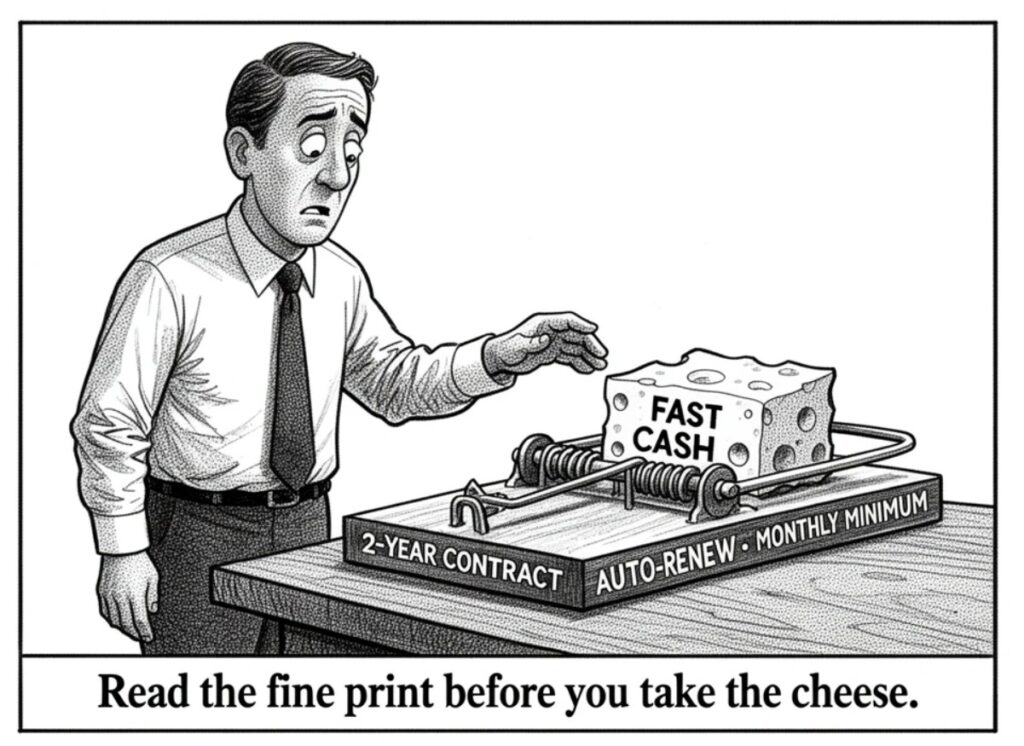
Here’s the part of the industry worth knowing: a lot of factors ask you to sign a one- or two-year contract, and many of those contracts auto-renew for another full term unless you cancel inside a narrow window. That’s how a company that only needed a bridge for a busy season ends up factoring for three years. The commitment length — and the auto-renewal clause hiding under it — is the first thing you should read, not the last.
Our agreement doesn’t have a term length at all. There’s no one-year or two-year commitment, and there’s nothing that auto-renews on you. You factor when it helps your cash flow and you don’t when it doesn’t — and because we let you decide which invoices to factor rather than requiring your whole book, you’re never signing up to hand over a fixed amount of business for any period of time. The point is simple: you should be able to see the end of the commitment from the day you start, and with us there isn’t one to see.
Short answer: no. We have no contractual monthly minimum, so a slow month never triggers a shortfall fee.
This is the trap that surprises people most. A monthly minimum means you’re expected to factor a certain dollar volume — or pay fees as if you had. Factor less than the minimum in a slow month, and you’re charged on the shortfall for invoices you never sold. It’s a real cost that never shows up in the headline rate, and for a seasonal or uneven business it can quietly erase the benefit of factoring altogether.
We don’t have a contractual monthly minimum. You’re never charged for cash flow you didn’t use, and a slow month is just a slow month — not a shortfall fee. If another factor does have a minimum, that’s not automatically a dealbreaker, but you need it in writing, in dollars, so you can run it against your slowest month and not just your best one.
Short answer: nothing. There’s no term to cancel out of — when your balance is paid off, we release the UCC-1 lien and you’re free and clear.
Ask this before you sign, every time. Some agreements carry a termination fee — often a percentage of your facility size — if you leave before the term is up. Others require 30, 60, or 90 days’ written notice, and if you miss the notice window, the contract quietly renews and the clock starts over. Neither of these is necessarily wrong, but both are the kind of thing you want to know going in, not discover on your way out.
With us, there’s nothing to cancel, because there’s no term to cancel out of. Since the agreement has no length, there’s no early-termination fee — there’s no “early” for you to be. When your outstanding balance is paid off, we release the UCC-1 lien (the standard filing that secures our position on the invoices while you’re factoring), and you’re free and clear. No notice-period games, no exit penalty, no wall built around the door. A factor confident in its own service doesn’t need one.
Contract length, minimums, and cancellation are the terms that decide whether you’re locked in, but a few other clauses shape the day-to-day of the relationship. Here are the ones worth understanding before you sign — with any factor, us included:
• Advance rate — the share of each invoice you’re paid upfront, often around 70–90%. The rest becomes your reserve.
• Reserve — the portion held back until your customer pays. It’s released to you, minus the fee, once the invoice clears.
• Factoring fee (discount rate) — what factoring actually costs, usually a percentage of the invoice that grows the longer it stays unpaid.
• Recourse vs. non-recourse — who absorbs the loss if your customer never pays. Recourse means you buy the invoice back; non-recourse means the factor covers a qualifying default. Most “non-recourse” still has conditions, so read what’s actually covered.
• Notice of assignment — the standard letter telling your customer to send payment to the factor instead of to you.
• UCC-1 filing — the routine lien that secures the factor’s position in your receivables while you factor. Ours is released once you’re paid off.
You don’t have to memorize the fine print. You just have to make any factor say it out loud. Before you sign, ask them to walk you through these seven things in writing:
1. How long is the contract, and does it auto-renew?
2. Is there a monthly minimum — and a fee if I don’t hit it?
3. How much notice does it take to cancel, and is there a termination fee?
4. Is it recourse or non-recourse — and what exactly is covered?
5. What’s the advance rate, and what’s the factoring fee?
6. Are there other fees (ACH or wire, monthly service, due-diligence, or setup)?
7. What happens if a customer pays late or disputes an invoice?
A factor who answers all seven plainly is showing you how they’ll treat you for the length of the relationship. A factor who gets vague is telling you something too.
At American Commercial Capital, our whole model is built on you wanting to stay, not being locked in. If that’s the kind of factor you’re looking for, request a free quote and we’ll show you exactly what your terms — and your advance — would look like. No fine-print surprises.
Related reading
• How Much Does Invoice Factoring Cost — and How Is My Rate Determined?
• Can I Factor Invoices Without Losing Control of My Business?
• Recourse vs. Non-Recourse Factoring: What’s the Difference?
• What Questions Should I Ask a Factoring Company? • Frequently Asked Questions About Invoice Factoring


Short answer: For most small businesses with a gross margin above roughly 20%, invoice factoring pays for itself — not because the fee is small, but because the fee is a variable cost that buys sales volume. A machine shop doing $1.2 million a year at a 28% gross margin can add $600,000 in sales, absorb a 4% factoring fee, and still finish the year with roughly 80% more…
Part of our Honest Answers series — straight talk about financing a growing business.
When you start factoring, we send your customer a letter. It tells them to send your payments to us instead of to you.
We call it a first-time purchase letter. The industry calls it a Notice of Assignment. Most guys call it “that letter you send my customer,” and it’s the part they…
Honest Answers from American Commercial Capital
Most advice about starting a B2B business with no money skips the hard part. It tells you to “bootstrap,” “hustle,” and “find investors.” Two of those are useful. The third one costs you the thing you started the business to get in the first place.
Here’s the honest answer: you can start a B2B business with no money — or close…



HOW MUCH COULD FACTORING INCREASE PROFITS FOR YOUR BUSINESS?
CALL 713-227-3863