AMCOMCAP.COM BLOG
WORDS OF WISDOM FOR ENTREPRENEURS & BUSINESS OWNERS

When business owners start looking into invoice factoring, two words come up fast: recourse and non-recourse. They sound like fine print, and plenty of owners nod along without really knowing which one they’re signing up for. But this is one of the most important choices in any factoring agreement, because it decides who eats the loss if your customer doesn’t pay. After decades of financing small businesses, I can tell you it’s worth slowing down to understand — and I’ll clear up the one misconception that trips almost everyone.
Let me lay it out plainly.
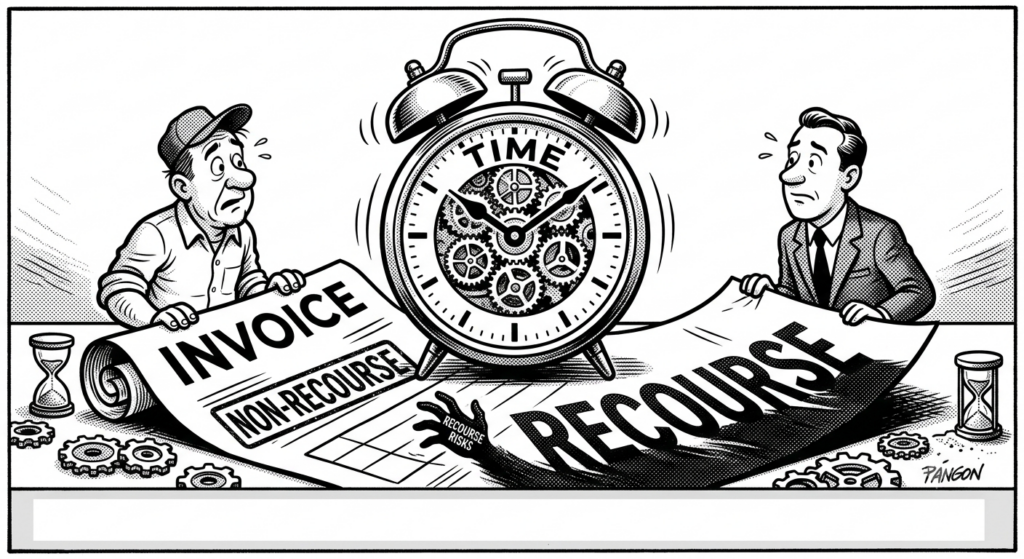
With recourse factoring, you keep the credit risk. You sell us your invoice, we advance you the cash, and we collect from your customer as usual. But if that customer ultimately doesn’t pay — usually after a set period, often 90 days — the invoice comes back to you. You either buy it back or swap it for another invoice of similar value.
The word “recourse” simply means we have recourse to you if the invoice goes unpaid. It sounds intimidating, but in practice it’s the most common arrangement, and for good reason.
With non-recourse factoring, we take on the credit risk. If your customer can’t pay because they’ve gone insolvent or bankrupt, that loss is ours, not yours. You keep the money we advanced and you don’t have to buy the invoice back.
For an owner worried about one big customer going under, that protection can be worth a lot — a single unpaid invoice from a major client can sink a small company. Non-recourse shifts that specific danger off your plate.
Here’s the part I make sure every client understands: non-recourse does not mean “no risk” or “guaranteed payment no matter what.” That’s the single most common misunderstanding I see, and it leads to some unpleasant surprises. It’s one of several myths about factoring that keep good companies from getting the cash they’ve earned.
Non-recourse protects you against one specific thing — your customer’s inability to pay because they’ve become insolvent. It does not cover the everyday reasons an invoice goes unpaid. If your customer withholds payment because of a dispute over your work, a short shipment, a billing error, a quality complaint, or a contract disagreement, that invoice is still your responsibility. Non-recourse covers the customer who can’t pay, not the customer who won’t pay because something went wrong on the job.
So non-recourse is real protection, but it’s narrower than the name suggests. Read the agreement and know exactly which events are covered before you assume you’re bulletproof.
In practice, the line between recourse and non-recourse isn’t always all-or-nothing. In many cases we set up a hybrid: an invoice is non-recourse for a specific window of time, and once that window passes without payment, it converts to recourse and comes back to you.
There’s a plain reason for that structure. When we buy your invoices, we’re in the business of turning receivables into cash quickly — we’re not looking to sit on a disputed debt for six months chasing a customer who won’t pay because something went wrong on the job. The non-recourse window protects you against a customer who genuinely can’t pay, while the conversion to recourse keeps a stale, disputed invoice from becoming an open-ended liability on our books. It’s a fair split: we carry the real credit risk up front, and long-running disputes — which are usually about the work, not the customer’s solvency — stay where they belong, with you.
Every deal is a little different, so we’ll spell out the exact timeframe and terms up front, in plain English.
Protection isn’t free. Because the factor is absorbing more risk in a non-recourse deal, non-recourse factoring generally costs more — a higher fee, and sometimes a lower advance rate — than a comparable recourse arrangement. Recourse factoring, where you retain the risk, is usually cheaper and often comes with a higher advance. It’s worth understanding exactly how your factoring rate is determined and which fees to watch for, so you can compare the two structures on real numbers instead of the label alone.
You’re really choosing between two things: pay a little less and carry the credit risk yourself, or pay a little more and hand the insolvency risk to us. Neither is “better” in the abstract — it depends on your situation.
One thing surprises new clients: in factoring, we care less about your credit than about your customers’ credit. That’s especially true with non-recourse. If we’re going to absorb the risk of a customer failing, we’re going to look closely at whether that customer is financially solid.
This is actually good news for you. It means a young or credit-challenged business can often qualify to factor invoices owed by strong, established customers — you don’t need perfect credit to factor, and factoring affects your business credit differently than taking on a loan would. But it also means non-recourse coverage typically applies only to customers we’ve approved as creditworthy. If you invoice a shaky customer, we may not extend non-recourse terms on that account — the protection follows the strength of who owes the money.
A few honest questions point you to the right answer — and they’re worth raising when you interview any factoring company:
How strong and how concentrated are your customers? If most of your revenue rides on one or two large accounts, the insolvency protection of non-recourse can be worth the extra cost. If your risk is spread across many solid customers, recourse may be all you need.
How’s your margin? If your margins are thin, the higher non-recourse fee may cost more than the risk it removes. If your margins are healthy and one bad debt would really hurt, paying for protection makes sense.
What keeps you up at night? Some owners sleep better knowing a customer bankruptcy can’t take them down, and happily pay for that. Others would rather keep the lower cost and manage the risk themselves. There’s no wrong answer — just the one that fits how you run your business.
Most of the small businesses we work with end up on recourse factoring, and they do just fine. It costs less, the advance is usually higher, and when they factor invoices to reliable customers, the odds of a buyback are low. Non-recourse earns its keep in specific situations — big customer concentration, or a client whose failure would be catastrophic — but it’s not automatically the safer choice just because of the name. The smart move is to match the structure to your real risk, not to pay for protection you don’t need or skip protection you do.
Recourse and non-recourse come down to one question: if a customer doesn’t pay because they’ve gone under, who absorbs it? With recourse, that’s you, in exchange for a lower cost. With non-recourse, that’s us, in exchange for a higher fee — and only for the specific credit events the agreement spells out. Understand what’s covered, look honestly at your customers and your margins, and the right choice usually becomes clear.
At American Commercial Capital, we’ll walk you through both options in plain English and help you pick the structure that actually fits your business — no jargon, no surprises. If you’re weighing recourse against non-recourse, let’s talk it through.
Get a free, no-obligation quote. Call Roy Brooks at 713-227-3863, or apply online to get started.
Roy Brooks, American Commercial Capital. We provide invoice factoring and accounts receivable financing to small businesses across Texas — Houston, The Woodlands, Dallas, Austin, and San Antonio.


Short answer: For most small businesses with a gross margin above roughly 20%, invoice factoring pays for itself — not because the fee is small, but because the fee is a variable cost that buys sales volume. A machine shop doing $1.2 million a year at a 28% gross margin can add $600,000 in sales, absorb a 4% factoring fee, and still finish the year with roughly 80% more…
Part of our Honest Answers series — straight talk about financing a growing business.
When you start factoring, we send your customer a letter. It tells them to send your payments to us instead of to you.
We call it a first-time purchase letter. The industry calls it a Notice of Assignment. Most guys call it “that letter you send my customer,” and it’s the part they…
Honest Answers from American Commercial Capital
Most advice about starting a B2B business with no money skips the hard part. It tells you to “bootstrap,” “hustle,” and “find investors.” Two of those are useful. The third one costs you the thing you started the business to get in the first place.
Here’s the honest answer: you can start a B2B business with no money — or close…



HOW MUCH COULD FACTORING INCREASE PROFITS FOR YOUR BUSINESS?
CALL 713-227-3863