AMCOMCAP.COM BLOG
WORDS OF WISDOM FOR ENTREPRENEURS & BUSINESS OWNERS

I’ve been in the factoring business since 1993, and I started American Commercial Capital in 2003. That means I’ve spent more than thirty years looking at the inside of small companies — their invoices, their aging reports, their customer lists, their payroll cycles.
It’s an unusual vantage point. A banker sees a polished loan package. An accountant sees last year. I see what’s happening this week, in real time, at hundreds of small businesses.
And here’s the thing that surprises people most about that view: the companies that get in trouble are usually the ones that are growing.
Not the ones limping along. Not the ones with a bad quarter. The ones with a full pipeline, a new crew, and more work than they’ve ever had. Growth is what most new entrepreneurs are chasing, and growth is the single most dangerous thing a young company does.
This article is about surviving it.
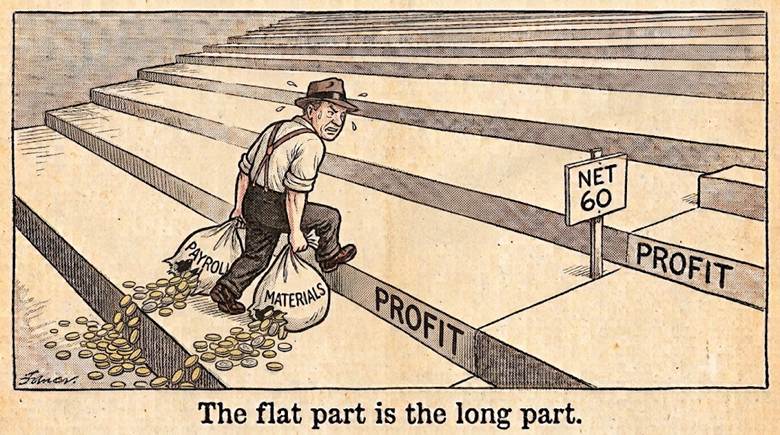
Visualize a stairway.
The tread is the flat part, and the tread represents time — the time you are spending money. You walk across it buying materials, making payroll, running trucks, covering the new hire. Nothing comes back while you’re on the tread. The longer your customer’s terms, the longer that stretch: net 30 is a short tread, net 60 is twice the walk, and every day of it comes out of working capital you already have. To a startup venture and a young entrepreneur alike, working capital is the lifeblood of your existence.
The riser is the step up, and the riser is profit. It only arrives at the end of the walk, when the invoice gets paid. That’s the moment you actually rise.
Every step comes in that order — walk first, rise later. Spend, wait, then climb.
Growth just means more steps, taken faster, with longer treads. That’s the whole risk in one sentence. And companies don’t fail on the riser. They fail out on the tread: cash spent, work delivered, invoice unpaid, payroll due Friday.
Everything below follows from that one picture.
You can be profitable on paper and still go under, and in a growth year it happens more often than most owners would guess.
You bill $80,000 in March, your costs were $60,000, you made $20,000. Congratulations. But you paid your people in March and your customer pays you in June. Profit shows up in the accounting. It doesn’t show up in the bank account for ninety days.
This is the same trap I’ve written about in why profitable startups still run out of cash — the levers most owners never think to pull. Businesses rarely die from unprofitability. That’s a slow death with plenty of warning. They die when they can’t make payroll on a Friday during their best quarter ever.
Survival skill: read your bank balance forward, not backward. What’s coming in, what’s going out, week by week, for the next thirteen weeks. A spreadsheet is fine. Doing it every Monday is what matters — and doing it especially when business is good. Knowing when the money lands is worth nearly as much as knowing how much.
New owners hear “we just landed a big account” as unambiguously good news. Sometimes it is. Often it’s the most dangerous week in the company’s life.
A bigger job means a longer tread: more cash going out across more days before the riser ever comes. Land several at once and you’re walking a long, flat, expensive floor with no step up in sight.
Survival skill: before you say yes, work out two numbers. What does this job cost you in cash before the first dollar comes back, and how many days pass before that dollar arrives? That’s the height and the length of the step you’re about to take. If the answer to “where does that money come from” is “I’ll figure it out,” you’re already out on the flat with no plan.
There’s a particular kind of order that shows up when you’re growing: big, exciting, and thin. The margin is half what you normally get, but the volume is triple, and the temptation to take it is enormous because it makes the year look like a success.
Do the arithmetic first. A low-margin job consumes the same working capital as a fat one — same materials, same payroll, same wait — and returns less at the end of it. Take enough of those and you can triple revenue while going broke, which is a genuinely miserable way to run a business.
This is why I always question a prospective client about their profit margins. It catches people off guard — they expect a finance company to ask about their credit, not their profitability. But I tell them straight: I don’t want to make more money on an invoice than they make fulfilling the order. If my fee is bigger than their margin on the job, the arrangement doesn’t work, and it doesn’t matter that it looks like it does on the first invoice. A client who’s losing money on the work isn’t going to be a client for very long.
Survival skill: growth in revenue isn’t the goal. Growth in excess cash flow should be the goal (or, as a nonprofit would say, cash reserves) — the money a job leaves behind after it’s been fully funded and fully collected. Think of it as another way to monitor profit, and an honest one, because it measures what the work actually put in the bank rather than what the income statement says you earned. If a job doesn’t throw off enough excess cash to justify the working capital it ties up for sixty days, it isn’t an opportunity — it’s an expensive way to look busy.
This one sneaks up on people precisely because it feels like winning. A good customer grows, you grow with them, you hire for them — and one morning 60% of your revenue sits with one purchasing manager.
At that point they don’t just buy from you, they control you. They can stretch your terms and you’ll take it. They can push your price and you’ll take it. And if they leave or go under, you go with them, with a payroll built for their volume.
Survival skill: if any customer is over about 30% of revenue, treat that as a signal to go sell — not a crisis, just a signal. The time to diversify is while they’re happy with you.
Every fixed monthly obligation you sign during a growth push — the lease, the truck note, the salaried hire — narrows the range of bad months you can survive afterward.
The trap is that growth makes fixed costs feel justified. You’ve got the volume now, so you buy the equipment and hire the crew. Then a customer slips 45 days, or the big job ends and the next one hasn’t started, and the obligations don’t care that the phone stopped ringing.
Survival skill: rent before you buy, subcontract before you hire, and let the growth prove itself for a couple of cycles before you make it permanent. Stay uncomfortable a little longer than feels dignified.
The most common reason a growing company waits ninety days on thirty-day terms isn’t a deadbeat customer. It’s a sloppy invoice.
Wrong PO number. No proof of delivery. Sent to the field super instead of accounts payable. Sent on the 15th for work finished on the 1st. Every one of those errors resets your customer’s clock, and nobody will call to tell you. The invoice just sits — and each day it sits is another day of tread you’re financing yourself.
This gets worse as you grow, because the volume goes up while the office help doesn’t.
Survival skill: invoice the day the work is done, to the right person, with the right reference number and documentation attached. Follow up on day 32 — not angry, just consistent. Shortening your collection cycle by ten days is the cheapest growth capital available to you, and most owners leave it on the table because chasing money feels rude.
I want to be blunt about this one, because growth squeezes are exactly when it happens.
When cash is tight and receivables are stacked up, the withheld payroll taxes sitting in your account look like available money. They aren’t. That money belongs to your employees and the government, and the IRS treats it differently from every other debt you have. The trust fund recovery penalty reaches through your LLC and lands on you personally, and it generally isn’t dischargeable in bankruptcy.
Survival skill: if you have to choose between paying a vendor late and paying payroll taxes late, pay the taxes. If the squeeze is really a timing problem rather than a profitability problem, payroll funding exists for exactly that gap. Every time. Call the vendor and talk to them like an adult — most will work with you. The IRS won’t.
The worst time to go looking for money is the week you’re desperate. You’ll take bad terms because they’re the only terms in front of you, and there’s an entire industry — merchant cash advances, daily-debit lenders — built to be standing there when you’re out of options.
Learn what’s available while things are calm: what a bank line actually requires, what an SBA loan takes and how long, what equipment financing looks like, and what invoice factoring actually does.
Factoring is our business, so take this for what it’s worth, but here’s the honest version in the language of the stairway: factoring shortens the tread. It doesn’t change the job, the margin, or the profit at the end of it. It just means you’re not the one financing the sixty-day walk between delivering the work and getting paid for it. That makes it useful once you have real customers and real invoices, and useless before that. If you get that far, the two questions worth answering next are what factoring costs and how your rate gets set and how to choose the right factoring company.
Survival skill: set up the facility when you don’t need it. Options are worth the most when you’re not being forced to use them.
The hardest discipline on this list is saying “not yet” to real work.
But growth has a maximum safe speed, and it’s set by how much working capital you have and how long your treads are. Exceed it and no amount of demand saves you. Plenty of good companies with full order books have gone under owing money to people who liked them.
Survival skill: know your number — how much cash you can have out on the floor at one time — and treat it as a real limit. Then go raise the limit deliberately: shorten terms, tighten collections, add a facility, build a reserve. Raise the ceiling first, then grow into it.
None of this is clever, and there’s no growth hack on the list.
What I’ve learned watching small companies from the inside for thirty-plus years is that surviving growth is mostly about respecting the order of operations. You spend, you wait, and then you rise. Every step, every time. The businesses that fail almost always did the first two parts faster than their cash could carry them.
Walk the tread with your eyes open, know what each step costs before you take it, and make sure you can pay for the flat part before you start counting the climb.
If you’ve got real customers and the wait on your receivables is the thing squeezing your growth, that’s the specific problem we solve — ask us for a quote and we’ll look at it honestly. If it isn’t, we’ll tell you so. We’ve told plenty of people no. It’s cheaper for both of us than the alternative.
American Commercial Capital, LLC 5200 Mitchelldale St, Ste E11, Houston, TX 77092 713-227-3863 | amcomcap.com


Short answer: For most small businesses with a gross margin above roughly 20%, invoice factoring pays for itself — not because the fee is small, but because the fee is a variable cost that buys sales volume. A machine shop doing $1.2 million a year at a 28% gross margin can add $600,000 in sales, absorb a 4% factoring fee, and still finish the year with roughly 80% more…

Part of our Honest Answers series — straight talk about financing a growing business.
When you start factoring, we send your customer a letter. It tells them to send your payments to us instead of to you.
We call it a first-time purchase letter. The industry calls it a Notice of Assignment. Most guys call it “that letter you send my customer,” and it’s the part they…
Honest Answers from American Commercial Capital
Most advice about starting a B2B business with no money skips the hard part. It tells you to “bootstrap,” “hustle,” and “find investors.” Two of those are useful. The third one costs you the thing you started the business to get in the first place.
Here’s the honest answer: you can start a B2B business with no money — or close…



HOW MUCH COULD FACTORING INCREASE PROFITS FOR YOUR BUSINESS?
CALL 713-227-3863