AMCOMCAP.COM BLOG
WORDS OF WISDOM FOR ENTREPRENEURS & BUSINESS OWNERS

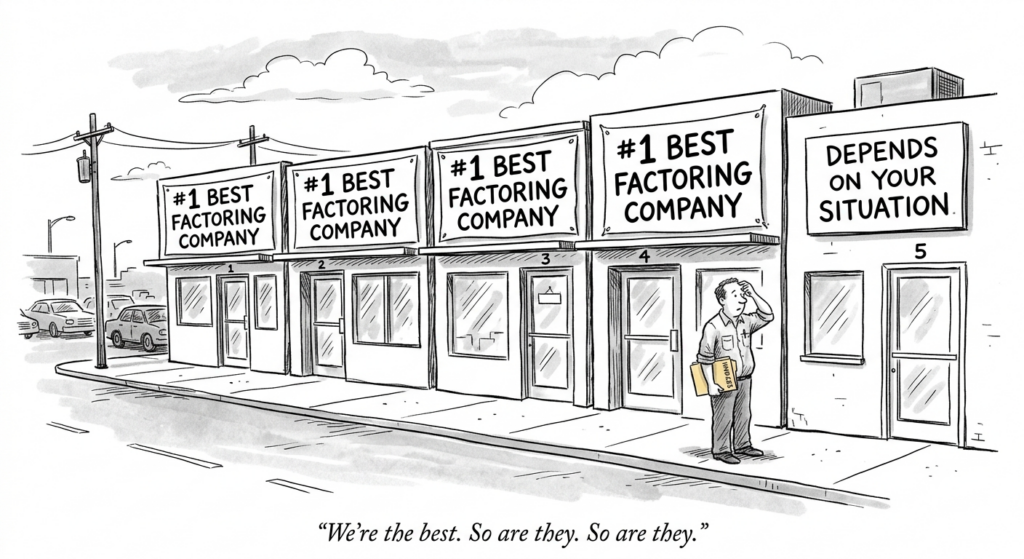
Short answer: There is no single best factoring company in Houston. There is a best factoring company for your business, and which one it is depends on your invoice size, your industry, your customers’ credit, how much hand-holding you need, and how much you’re willing to pay for speed. This article gives you the criteria to figure that out — including the questions that will get you an honest answer from any factor you call, including us.
Full disclosure before you read another word: I own American Commercial Capital, LLC. We are a Houston invoice factoring company. I have been in this industry since 1993 and have run ACC since 2003. You should read everything below knowing I have a horse in this race. I’ve written it anyway, because after thirty-plus years I’ve watched too many small business owners sign a factoring agreement they didn’t understand, and the article I wish they’d read didn’t exist.
Search that phrase and you’ll get a page of factoring companies each announcing that they are, in fact, the best. Every one of them is a paid advertisement or a self-written claim. None of them tell you what varies between one factor and another, which is the only thing that actually matters when you’re choosing.
Here’s what’s really going on. Invoice factoring is not a commodity. Two Houston factors can quote you what sounds like the same deal and deliver wildly different outcomes, because the cost of factoring is buried in five or six variables and only one of them is the headline rate.
A staffing agency in the Energy Corridor with $400,000 in monthly invoices to investment-grade customers needs a completely different factor than a two-truck carrier out of Pasadena hauling for freight brokers. The first one should be shopping national factors on price. The second one will be ignored by those same national factors and should be calling local independents.
So the useful question isn’t “who’s best.” It’s “what should I be comparing?”
The advertised rate is the discount fee — typically quoted as a percentage per 30 days, or in tiers. It is rarely the whole cost.
Ask for a written list of every fee that could ever appear on your statement. The usual suspects: application fees, due diligence fees, UCC filing fees, monthly minimums, wire fees, ACH fees, credit check fees, lockbox fees, termination fees, and misdirected payment fees. A factor quoting 1.5% with a $500 monthly minimum and a $35 wire fee per advance may cost a small client far more than one quoting 2% flat.
Ask this: “If I factor $50,000 in invoices next month across ten advances and they all pay in 45 days, what is my total cost in dollars?” A straight answer to that question tells you more than any rate sheet.
The advance rate is the percentage of the invoice you get up front. Most Houston factors advance somewhere between 75% and 90% depending on industry. We advance 80% on most accounts.
The remainder — the reserve — is held until your customer pays, then returned to you minus the fee. Be careful with any factor advertising a “100% advance.” That almost always means 100% minus fees deducted up front, which is a pricing structure, not a higher advance.
Ask this: “How quickly is my reserve released after my customer pays, and does it release automatically or do I have to request it?”
Under recourse factoring, if your customer never pays, you buy the invoice back. Under non-recourse factoring, the factor absorbs the loss. Non-recourse costs more.
Here’s the part that surprises people: most non-recourse agreements only cover customer insolvency — an actual bankruptcy filing. If your customer simply refuses to pay because they’re disputing the work, that’s not covered, and you’re buying the invoice back regardless of what the cover of the agreement says. Read the definition of the credit event in the contract, not the brochure.
ACC is a recourse shop and we say so plainly. Recourse pricing is lower, and in our experience most disputes between a small Texas business and its customer are about performance, not insolvency — which non-recourse wouldn’t have covered anyway.
Some agreements require you to factor all invoices from all customers. Others let you pick and choose, sometimes called spot factoring or selective factoring. Some require all invoices from selected customers.
Whole-ledger requirements get expensive if a large share of your customers pay quickly on their own. If you only need funding on your slow-paying accounts, you want selectivity.
Look for the initial term length, the auto-renewal language, the notice window required to cancel, and the early termination fee. A twelve-month auto-renewing agreement with a 60-day notice window and a termination fee equal to three months of minimums is a very different commitment than a month-to-month arrangement.
Ask this: “What’s the shortest path out of this agreement if it isn’t working, and what does that cost me?”
Factoring involves notifying your customers to pay the factor instead of you. That notification, and every collection call after it, happens in your name and reflects on your relationships.
This is the most underrated criterion on the list and the one where local factors most often beat national platforms. Ask who makes those calls. Ask what they say. Ask whether you get to review the notification letter before it goes out. A collections department that is aggressive with your best customer can cost you more than the entire factoring fee.
In factoring, the factor is primarily buying your customers’ creditworthiness, not yours. This is why factoring works for young companies, companies with tax liens, and companies a bank turned down.
But factors vary enormously in how much of your own financial picture they require. Some Houston factors will fund a six-month-old company on a signed invoice. Others want two years of financials before they’ll return your call. If you’ve been declined by a bank, filter for factors who lead with customer credit.
Industry knowledge shows up in the details. A factor who understands construction knows about retainage, pay-when-paid clauses, and mechanic’s lien deadlines. A factor who understands staffing knows your payroll runs Friday and the funding has to clear Thursday. A factor who understands oilfield services knows about field tickets and master service agreements.
Houston’s factoring demand concentrates in a handful of verticals: energy and oilfield services, freight and trucking along the I-10 and I-45 corridors, staffing, industrial manufacturing and machine shops, construction subcontractors, and IT services. Ask a prospective factor to describe the last three clients they funded in your industry.
At a small independent factor, you’ll likely deal with the owner or one account manager for the life of the relationship. At a large national platform, you’ll deal with a portal, a queue, and whoever picks up.
Neither is wrong. Larger operations often have better technology, higher credit limits, and lower rates at volume. Smaller ones give you a person who knows your name and can make a judgment call on a Friday afternoon. Decide which you actually need before you shop.
| Type | Typical fit | Strengths | Trade-offs |
|---|---|---|---|
| Bank-affiliated factors | Established companies, larger facilities | Lowest rates, deep capital, path to a bank line later | Stricter underwriting, slower onboarding, less flexibility on marginal deals |
| Large national factors | Freight carriers, staffing firms, standardized industries | Technology, fuel cards, same-day funding, high limits | Call-center service, rigid terms, whole-ledger requirements, long agreements |
| Local independent factors | Small B2B companies, $10K–$500K monthly volume, unusual situations | Owner access, judgment-based decisions, relationship-driven collections | Smaller credit limits, less technology, rates above bank-affiliated |
| Brokers and referral sites | Businesses who want options presented to them | One application, multiple offers | You aren’t talking to the funding source; commission is built into your rate |
Houston has real depth in all four categories — bank affiliates, national platforms with offices or coverage here, locally owned independents, and brokers. Any of the four may be the right answer depending on the nine criteria above. Before you start calling, decide which category you belong in, because it eliminates most of the market and saves you three weeks of conversations that were never going anywhere.
Call three companies. Ask each of these. Listen to how comfortable they sound.
We’re a small, Houston-based independent. We’ve been factoring Texas receivables since 2003, and I’ve been in the industry since 1993. We advance 80%, we’re a recourse shop, and you’ll deal with me or someone I work with directly rather than a portal.
We’re a good fit for small B2B companies in Texas — staffing agencies, machine shops, manufacturers, IT services firms, trucking companies, construction subcontractors, and oilfield service providers — generally in the range where a national factor’s minimums would eat you alive and a bank hasn’t said yes yet.
We’re the wrong choice if: you need a multi-million dollar facility, you want a self-service technology platform, you sell to consumers rather than businesses, you need non-recourse coverage, or you already qualify for a bank line of credit. In every one of those cases I’d rather tell you now than take an application.
If you want to talk through whether factoring makes sense at all — including hearing why it might not — that conversation is free and there’s no application involved.
Cost depends on invoice size, customer credit quality, monthly volume, and how long your customers take to pay. The discount fee is only part of it. Ask any factor to quote your total dollar cost on a realistic month of invoices rather than comparing advertised percentages.
Initial setup typically takes a few business days to two weeks depending on the factor and the complexity of your customer base. After setup, funding on submitted invoices is usually same-day or next-day.
Generally no. Factors underwrite your customers’ ability to pay, not yours. This is why factoring is available to companies that banks decline, including young companies and those with tax liens or prior credit problems.
Yes. Standard factoring requires notification so your customers pay the factor directly. This is normal and common in industries like staffing, freight, and oilfield services. What varies is how professionally that notification and any follow-up is handled — ask to see the notification letter before signing.
Under recourse, you buy back invoices your customer doesn’t pay. Under non-recourse, the factor absorbs the credit loss — but usually only for customer insolvency, not payment disputes. Non-recourse carries a higher fee.
Some factors allow selective or spot factoring; others require your whole ledger or all invoices from designated customers. If you only need funding on certain accounts, confirm selectivity in writing before signing.
Not inherently. National factors typically offer better technology, higher limits, and lower rates at volume. Local independents typically offer direct owner access, faster judgment calls, and more careful handling of your customer relationships. The right choice depends on your size and what you need most.
Staffing, freight and trucking, oilfield and energy services, industrial manufacturing and machine shops, construction subcontracting, and IT services — all industries with 30-to-90-day payment terms and payroll or fuel costs that come due first.
Roy Brooks is the founder and President of American Commercial Capital, LLC, a Houston invoice factoring company serving small B2B businesses across Texas since 2003. He has worked in the accounts receivable finance industry since 1993. This article is part of the Honest Answers series.


Short answer: For most small businesses with a gross margin above roughly 20%, invoice factoring pays for itself — not because the fee is small, but because the fee is a variable cost that buys sales volume. A machine shop doing $1.2 million a year at a 28% gross margin can add $600,000 in sales, absorb a 4% factoring fee, and still finish the year with roughly 80% more…

Part of our Honest Answers series — straight talk about financing a growing business.
When you start factoring, we send your customer a letter. It tells them to send your payments to us instead of to you.
We call it a first-time purchase letter. The industry calls it a Notice of Assignment. Most guys call it “that letter you send my customer,” and it’s the part they…
Honest Answers from American Commercial Capital
Most advice about starting a B2B business with no money skips the hard part. It tells you to “bootstrap,” “hustle,” and “find investors.” Two of those are useful. The third one costs you the thing you started the business to get in the first place.
Here’s the honest answer: you can start a B2B business with no money — or close…



HOW MUCH COULD FACTORING INCREASE PROFITS FOR YOUR BUSINESS?
CALL 713-227-3863