AMCOMCAP.COM BLOG
WORDS OF WISDOM FOR ENTREPRENEURS & BUSINESS OWNERS

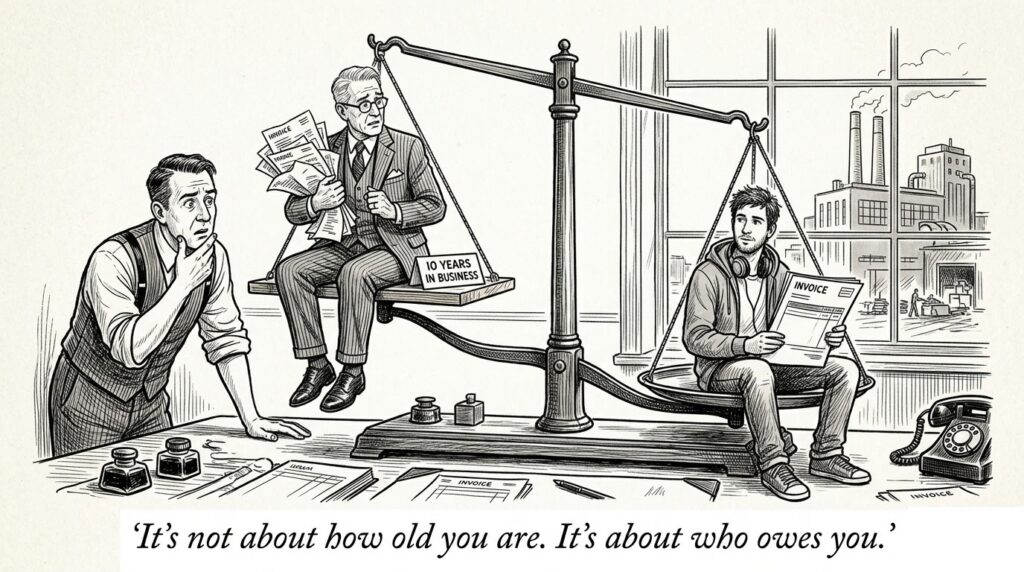
Most factoring companies will tell you they’re the best. I won’t, because “best” isn’t a real thing. The right factor for a $40-million oilfield services company isn’t the right factor for a two-truck carrier or an IT consultancy that just landed its first real client.
If you’re a newer company weighing this, it’s worth knowing whether your startup can use invoice factoring at all before you shop on price.
The useful question isn’t who’s best. It’s are we a fit for you. Here’s a straight answer, including the parts where somebody else is the better call.
A lot of founders assume factoring is for established companies and never bother calling.
I don’t underwrite you. I underwrite the companies that owe you money.
No operating history, no collateral, a bank that turned you down — none of that is the gate. The question is whether the customers you’re invoicing are good for the money and whether you actually did the work. A six-month-old dev shop invoicing a solid Houston manufacturer is more fundable than a ten-year-old company invoicing shaky customers.
In fairness, that’s true at most factors. It isn’t my differentiator. It’s just what you needed to know before reading further.
If you’re still in the earliest stage, we also wrote about how to start a B2B business with little or no money and keep full ownership of it.
I’m an old tech guy. B.B.A. from Texas A&M in Management Information Systems, 1983, then years as a mainframe COBOL programmer.
Which meant a lot of nights driving into the office at 2 AM in the morning because a batch job had abended (blown up) in the middle of the run. I’d pull the core dump and start walking offsets, hunting the one piece of bad data that had come in from upstream and knocked over a program somebody wrote years before I got there. I’d add an edit to prevent future blowups, compile the program, rerun the job, and drive home as the sun came up.
I’m aware COBOL doesn’t translate line for line to whatever you’re deploying this afternoon. I won’t pretend I can review your pull request.
But here’s what those 2 AM drives were actually about: catching bad data before it wrecked everything downstream. That’s all an edit is. You don’t trust the input — you verify it, at the front, so nobody gets a call in the early morning hours.
That is also precisely what factoring is. I check whether your customer is good for the money. I verify the invoice is real and the work was accepted. Up front, before I advance a dollar. Different system, same job. I’ve been doing some version of it my whole working life.
The practical upshot: I understand how you bill. Milestones. Time-and-materials against a SOW. A retainer with an overage. Your proof of delivery isn’t a signed bill of lading — it’s a client sign-off, an accepted sprint, a closed ticket. A factor who’s only funded freight will look for a delivery receipt, not find one, and get nervous. I’ll ask you the right question instead: what’s your acceptance criteria, and who signs off on it?
I also wrote the accounts receivable system this company still runs on. So when I say I know what it costs to maintain something you shipped years ago, that’s not a figure of speech.
Not that I’m current. That I’ve been on both sides of an invoice like yours.
You’re small and will be for a while. I’ve funded businesses whose first month was a single invoice. No volume floor, and no month where I call to ask why you didn’t factor enough.
That willingness to start small is one of the reasons businesses come to us in the first place.
You’re small, and you’d like to be treated that way. The national factors will take a small account — most of them advertise no minimums. But their economics are built on volume, and attention follows the big accounts. At $20,000 a month you are a rounding error to a shop with 2,000 clients. Here you’re a client I know by name.
You’re a dev shop, IT consultancy, or technical services firm. Payroll is your whole cost structure and it’s due Friday. Your client is on net-45. That mismatch is the textbook case for factoring.
You want one person who knows your account. We’re one office, on Mitchelldale Street in Houston. I founded this in 2003 and I’ve been in the business since 1993. When you call with a problem, the person deciding what to do about it is me — and it’ll still be me in six months. At a national shop, your account manager is terrific right up until she’s promoted, and then you start over with someone who’s never heard of you.
If you need the highest advance rate, we’re not it. Houston factors publish advances from about 80% up to 98%. We advance up to 80% — the bottom of that range, and I’m not hiding it. The reserve I hold back is what absorbs a short-pay or a disputed invoice without my chasing you for money you’ve already spent. A 98% advance leaves two points of cushion. I’d rather hold a bit more and never make that call. If you disagree, take the higher advance. Go with my blessing.
If you want true non-recourse, we’re not it. Some factors assume the credit risk outright. My program covers you if your customer goes bankrupt within 75 days. After that — or if they don’t pay because of a dispute with you — you buy the invoice back. Worth knowing: non-recourse costs more, and everywhere it’s offered you still repurchase for disputes and performance problems.
If you invoice consumers, factoring isn’t your answer. We buy business-to-business invoices.
The work has to be done. Completed, delivered, accepted. If you’re a dev shop, that means the sprint is accepted — not that it’s in review.
Call three of us and ask each the same things:
Write down the answers and pick the best fit. If that’s a 90% advance somewhere else, go. But if you’d rather explain your milestone billing to someone who’s actually written code and shipped it — and who’ll still be answering the phone next year — call me.
713-227-FUND.
If that sounds like the kind of factor you want, request a free quote and we’ll show you what your advance would look like.


Short answer: For most small businesses with a gross margin above roughly 20%, invoice factoring pays for itself — not because the fee is small, but because the fee is a variable cost that buys sales volume. A machine shop doing $1.2 million a year at a 28% gross margin can add $600,000 in sales, absorb a 4% factoring fee, and still finish the year with roughly 80% more…

Part of our Honest Answers series — straight talk about financing a growing business.
When you start factoring, we send your customer a letter. It tells them to send your payments to us instead of to you.
We call it a first-time purchase letter. The industry calls it a Notice of Assignment. Most guys call it “that letter you send my customer,” and it’s the part they…
Honest Answers from American Commercial Capital
Most advice about starting a B2B business with no money skips the hard part. It tells you to “bootstrap,” “hustle,” and “find investors.” Two of those are useful. The third one costs you the thing you started the business to get in the first place.
Here’s the honest answer: you can start a B2B business with no money — or close…



HOW MUCH COULD FACTORING INCREASE PROFITS FOR YOUR BUSINESS?
CALL 713-227-3863